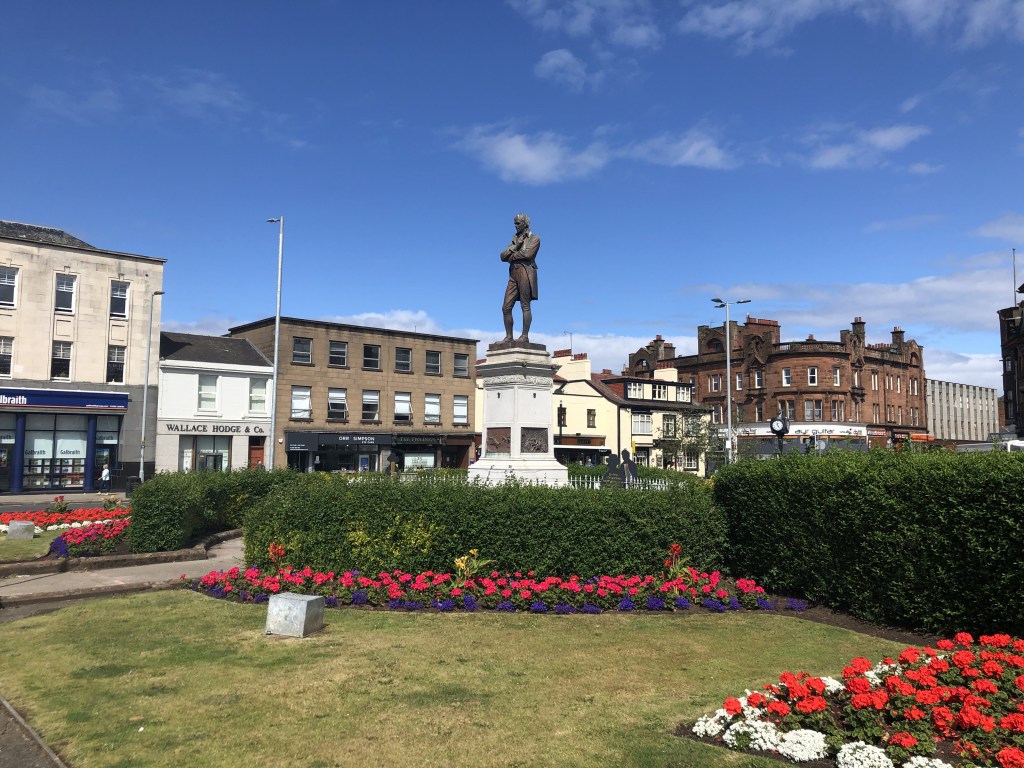
Robert Burns was born in Alloway, near Ayr on January 25th, 1759. For the first years of his short life, he lived in a cosy but humble cottage, which he shared with his expanding family and their cattle, who also shared the small space. The house has been preserved by the National Trust for Scotland and is the highlight of an attraction that incorporates many Burns-related places.
Ayr is a very nice little town and has a good selection of stores selling sweets and souvenirs. A whisky shop or two (yes, I did visit one and yes, I did spend too much). One of the pubs claims to be the very one where Tam O’Shanter spent the evening carousing with Souter Johnnie before his adventure began. When I visited the town, on a glorious day in late July, shoppers were shopping, sightseers were seeing sights, street musicians entertaining and there was even a preacher preaching. The town makes a great deal of its Burns connection: as well as the statue of Burns and the church at which h the family worshipped, there are Burns newsagents, Burns gift shops and Burns cafés. The local hospital even has a Burns unit! (I’m rather pleased with this joke and repeat it quite frequently. My audience seem less than enthusiastic, however. My comic genius is met with eye-rolls, tuts and, occasionally, open hostility.)
Ayr is a seaside town and has a nice, sandy beach, backed with kiosks selling ice cream, snacks and beach games. Mrs. P loves beachcombing. She can spend hours and hours wandering the high-water-mark in search of flotsam and jetsam that washes up on the nation’s beaches and ends up in our living room. I quite enjoy the activity too but for me, it’s the occupation of few minutes; not an entire afternoon. So I left her wandering happily along beside the sea and went to visit the house in which Robert Burns was born.
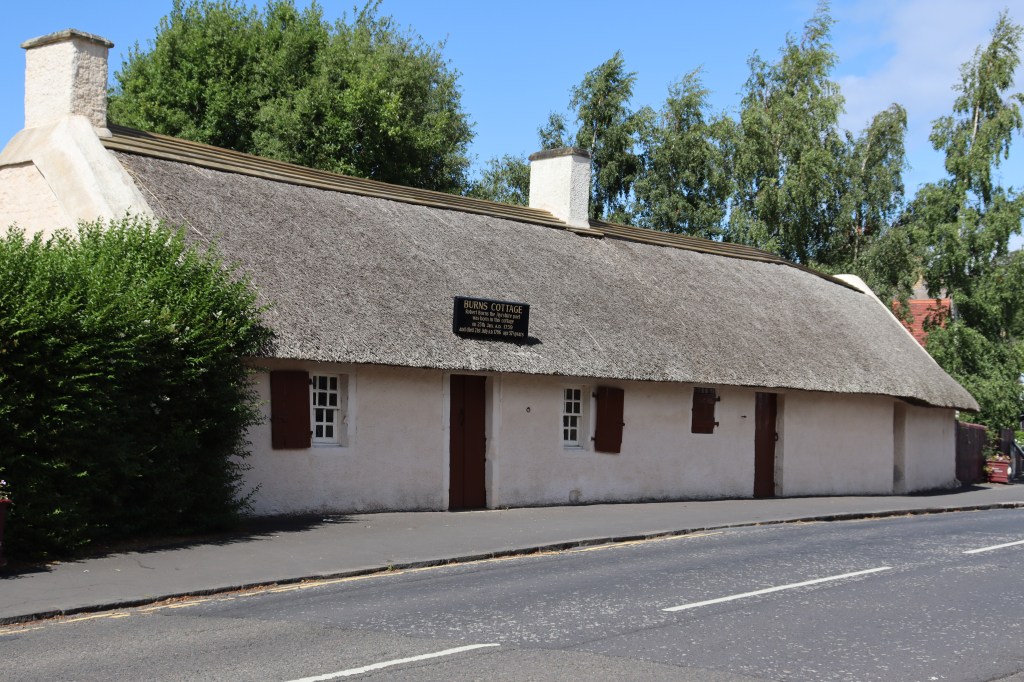
The cottage has been preserved as a museum and inside you will find i furnished as it would have been when Burns occupied it, but the furnishings have been arranged to represent different aspects of 18th century cottage life. There are extracts from his poems written on the walls, alongside dialect words he would have used. It is a charming little cottage, surrounded by a cottage garden, where the Burns family would have tended a few crops. I felt closer to Burns here than I did at his later homes in around Dumfries, especially as one of his poems, Tam O’Shanter, is so closely bound with the town and environs of the cottage.

I enjoyed the cottage very much, particularly the box bed where the poet and his siblings were born, a nightshirt for each of the children brought into the world there, hovers ghost-like over the bed, atmospherically lit from within. I also learned a lot about farming practices, milking and calving taking place in a room within the cottage itself. There is an education and conference centre here too, spreading the words of the Bard to future generations, and there are some pleasant walks through the countryside around the cottage.

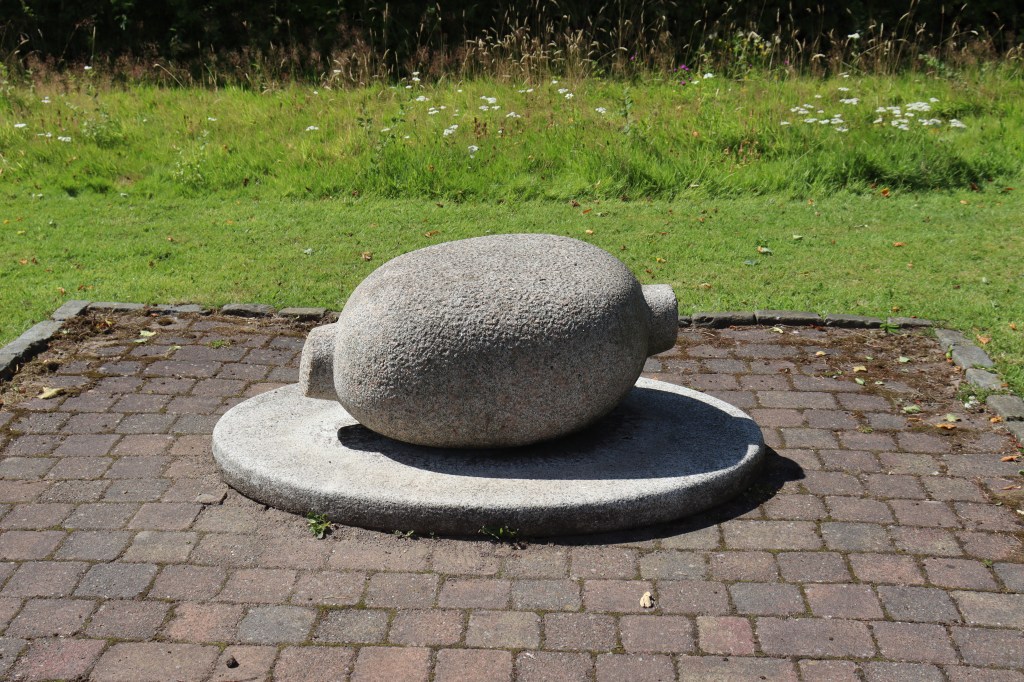
A short walk along the ‘Poet’s Path’ will take you to the visitor centre. This pathway is lined with sculptures. In each one the artist has tried to envision one of Burns’s poems. I particularly liked the giant mouse, the haggis and the Twa Dogs, which incorporates a bench, on which you can sit and rest. So that’s what I did. It was a nice walk along the path, enjoying the sculpture and spotting which poem each was meant to represent.
The visitor centre houses a museum, a shop and a café, which was where I headed next. I had a selection of Scottish cheeses, served with fruit, pickles and fresh bread. Very good it was too, though I felt the wait, queueing cafeteria style at a food counter, could have been shorter. The museum is a wonderful experience. The lights are low because of the sensitive nature of the books and papers on display, but this gives it an atmospheric ambience. There are, among the hundreds of Burns possessions and rememberances on display, some interactive exhibits. Families, some with very young children, were enjoying pressing buttons and listening the commentary and music which played as a result of their choices.

The exhibits are arranged thematically, so you can wander around at your leisure, not forced into following a set route. It makes a beautifully organised show, into which you could spend hours if you so chose, poring over the plethora of objects on display, or you could just dip in, a visit of minutes being almost as rewarding. As a whole, the exhibit displays the huge worldwide influence of burns and his importance to Scots living throughout the world.
I visited the shop on the way out, and bought a few keepsakes, then headed for the Auld Kirk, just across the road. William Burnes, Robert’s father, is buried here, his grave marked out by an iron chain fence. The Kirk is in ruins and the graveyard overgrown. You can peer through railings to see some of the macabre artefacts, such as the iron coffin guards, installed to prevent grave robbers desecrating the mortal remains of the parishioners. It is an atmospheric and evocative place and it is easy to see how Burns imagined it as the site of a witches’ sabbath. It is here that Tam sees “Warlocks and witches in a dance”

There is a fine monument to the poet, a 20m high greek temple designed by Sir Thomas Hamilton and visible from throughout the surrounding area. It sits in a lovely memorial garden, surrounded by roses. Inside there are statues of Burns and some representing his characters, such as Tam and Souter Johnnie. There are fine views from the top and a wonderful vista of Brig O’Doon, where Tam escapes Cutty Sark, who has pursued him holding his horse’s tail.

It was a wonderful way to spend an afternoon, particularly if rounded off with a visit to the Brig O’Doon Inn: a fine looking pub next to the new bridge across the River Doon. Not for me today, though. I was off to collect Mrs. P. and we were going in search of tea and ice cream, which we found after a short drive along the coast to Kirkoswald, where Souter Johnnie’s cottage is: a recreated shoemaker’s cottage and workshop, commemorating Tam O’Shanter’s drinking pal.
The whole area is rich in Burns heritage, with houses and farms wherein the family lived and worked, throughout the region. You will find Burns in Irvine, where he worked as a flax dresser, or ‘Heckler’; in Kilmarnock, where his first book was published; in Mauchline, where he spent his most productive years as a poet. We spent the next few days motoring around the beautiful Ayrshire countryside, seeking out little towns and villages where people have chosen to honour this most loved of writers.
 Literary Britain
Leave a comment